
Small and medium-sized enterprises represent a major part of Europe’s industrial economy, yet many SMEs still struggle to implement meaningful energy efficiency improvements despite the availability of audits, recommendations and technical guidance. Limited resources, lack of technical capacity and difficulties accessing finance often prevent companies from translating identified opportunities into real operational change. DEESME addresses this challenge by helping SMEs move beyond compliance-driven energy audits towards practical decarbonisation and energy management strategies.
The project supports companies in transforming energy audits into actionable business tools that improve competitiveness, reduce emissions and strengthen long-term resilience. By combining energy efficiency with broader sustainability and management approaches, DEESME helps SMEs integrate decarbonisation into everyday business decision-making rather than treating it as a separate technical exercise.
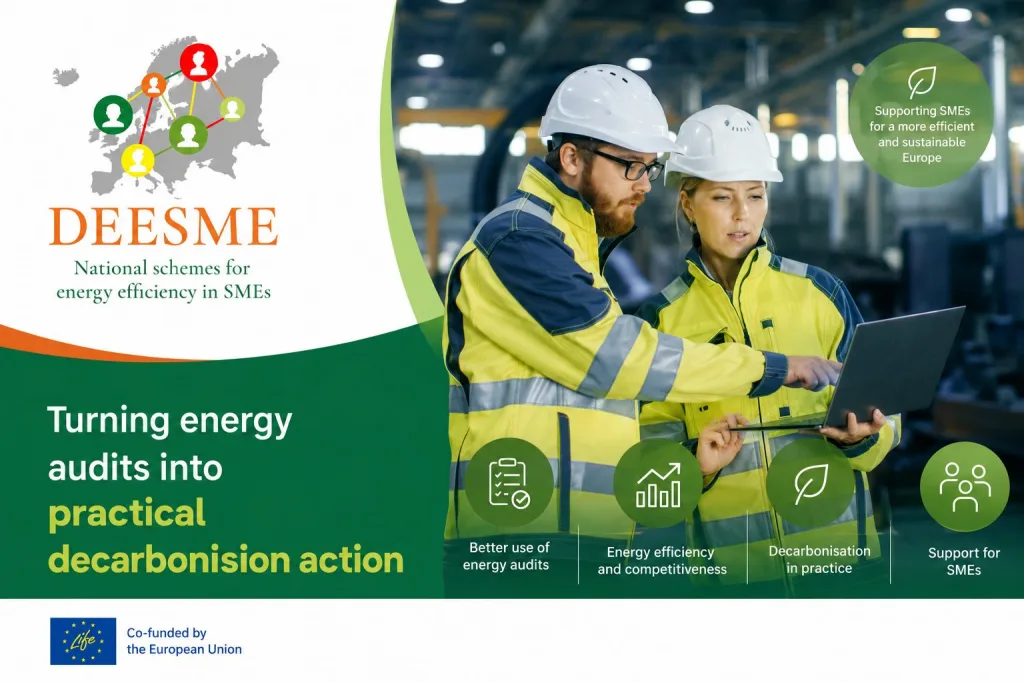
What is DEESME about?
DEESME focuses on improving how SMEs approach energy efficiency, energy audits and energy management systems across Europe.
The project recognises that many companies already conduct energy audits but often fail to implement the identified measures due to financial, organisational or technical barriers. DEESME works to close this implementation gap by developing practical methodologies, guidance frameworks and support mechanisms tailored specifically to SME realities.
A key objective of the project is to make energy audits more useful as strategic business instruments. Rather than producing isolated technical reports, DEESME promotes integrated approaches that connect energy efficiency with broader operational improvements, sustainability objectives and long-term business planning.
The project also supports the uptake of energy management systems within SMEs, helping companies establish continuous improvement processes instead of one-off efficiency interventions. Capacity-building activities, training programmes and policy recommendations are designed to increase awareness and improve the ability of SMEs to identify, prioritise and implement energy-saving measures.
In parallel, DEESME explores how financial and policy frameworks can better support SME decarbonisation efforts. The project works with policymakers, industry associations and business support organisations to develop recommendations that improve the accessibility and effectiveness of energy efficiency schemes for smaller companies.
By combining technical guidance, stakeholder engagement and policy support, DEESME aims to accelerate practical decarbonisation across Europe’s SME sector.
From Energy Audits to Business Transformation
One of the key lessons behind DEESME is that energy efficiency measures are most successful when they are linked to broader business objectives. For many SMEs, investment decisions are driven not only by energy savings but also by factors such as productivity improvements, operational reliability, cost reduction and long-term competitiveness. DEESME therefore encourages companies to view energy audits as part of a wider strategic process rather than a standalone compliance exercise.
By helping businesses identify the operational benefits associated with energy efficiency measures, the project supports stronger decision-making and increases the likelihood that recommended actions are implemented. This integrated perspective allows SMEs to connect decarbonisation efforts with business growth, resilience and innovation, creating a stronger foundation for continuous improvement and long-term sustainability.
Why DEESME matters
SMEs account for a substantial share of Europe’s industrial activity and energy consumption, making their participation essential for achieving Europe’s climate and energy objectives. However, many smaller companies face structural barriers that limit their ability to invest in energy efficiency improvements.
DEESME contributes to overcoming these barriers by helping SMEs convert energy efficiency from a compliance obligation into a driver of competitiveness, resilience and sustainability. The project supports companies in reducing operational costs, improving energy performance and strengthening their preparedness for future climate and regulatory requirements.
By improving the quality and implementation of energy audits and management practices, DEESME helps create more practical pathways for industrial decarbonisation across Europe’s SME landscape.
Explore further
This project has received funding from the European Union’s Horizon 2020 research and innovation programme under Grant Agreement No. 892235.
Views and opinions expressed are however those of the author(s) only and do not necessarily reflect those of the European Union or the European Commission. Neither the European Union nor the granting authority can be held responsible for them.
