
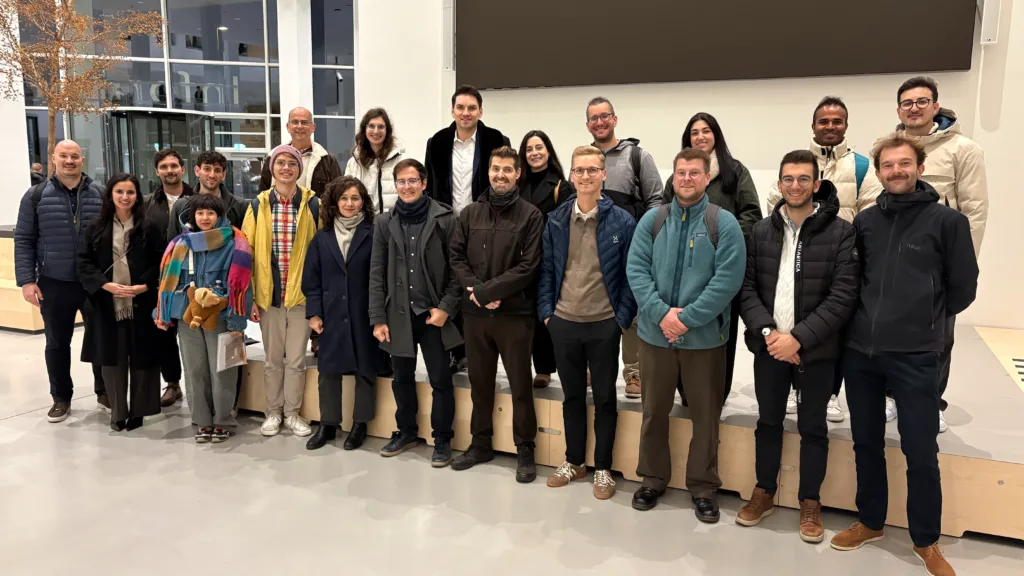
On 4–5 November 2026, Energy Efficiency in Industrial Processes (EEIP) joined the DMaaST consortium in Karlsruhe, Germany, for two days of project discussions, knowledge exchange and collaborative planning. Hosted by Karlsruhe Institute of Technology (KIT), the meeting brought partners together to review progress and coordinate the next steps towards more resilient, efficient and sustainable manufacturing systems.
The meeting offered an opportunity to connect the different strands of work taking place across the project and consider how they contribute to its wider objectives. For EEIP, which supports the project’s communication, dissemination and exploitation activities, these exchanges are particularly valuable in ensuring that emerging knowledge and results can reach the industrial stakeholders who may benefit from them.
Connecting Digital Manufacturing Innovation with Industry Needs
The DMaaST project, funded by the European Union’s Horizon Europe programme, is developing advanced digital modelling and assessment capabilities to help manufacturing ecosystems respond more effectively to changing conditions and disruptions. Its approach brings together technologies such as cognitive digital twins, interoperable data systems and artificial intelligence to support better-informed decisions across manufacturing processes and value chains.
Alongside improving industrial resilience, DMaaST addresses important challenges related to sustainability, circularity and resource efficiency. By connecting manufacturing data with advanced modelling and decision-support capabilities, the project aims to help industrial stakeholders better understand their operations, evaluate alternatives and adapt to evolving requirements.
The consortium meeting in Karlsruhe provided an opportunity to review ongoing activities, exchange insights between partners and discuss priorities for the next stages of the project. Such exchanges are important in a multidisciplinary initiative like DMaaST, where technological development, industrial requirements and the practical application of research need to remain closely connected.
EEIP’s Role: Bringing Project Knowledge Closer to Industry
Within DMaaST, EEIP contributes to communication, dissemination and exploitation activities, helping to connect the project’s research and innovation work with wider industrial and stakeholder communities. This includes supporting the visibility and accessibility of project developments and contributing to the dissemination and exploitation of knowledge generated by the consortium.
For EEIP, participation in meetings such as the one in Karlsruhe is an important part of this work. Direct exchanges with technical and industrial partners provide valuable context for communicating complex developments in a way that is relevant and understandable to audiences beyond the consortium. They also help maintain a shared perspective on how project outcomes can be communicated and made useful to stakeholders interested in digital transformation, industrial resilience and sustainable manufacturing.
As DMaaST progresses, these connections between technical innovation, industry needs and knowledge dissemination will remain important for supporting the project’s longer-term impact.
Continuing the Collaboration
The Karlsruhe meeting reinforced the importance of close cooperation across the consortium as partners work towards their shared objectives. Beyond reviewing progress and coordinating upcoming activities, meeting in person provided space for constructive discussions and stronger working relationships, both essential for a collaborative European research and innovation project.
EEIP would like to thank Karlsruhe Institute of Technology (KIT) for hosting the meeting and for the excellent organisation and hospitality throughout the two days. We look forward to continuing our collaboration with the DMaaST partners and supporting the dissemination and wider uptake of the project’s developments.
Discover more about DMaaST, its objectives and ongoing activities through the official project website!
Funding Acknowledgement
Project financed by: Horizon Europe Programme, HORIZON-CL4-2023-TWIN-TRANSITION-01-07. Views and opinions expressed are however those of the author(s) only and do not necessarily reflect those of the European Union. Neither the European Union nor the granting authority can be held responsible for them.
