
Forging and casting are among the most energy-intensive manufacturing processes in Europe. While significant amounts of heat are generated during production, conventional heat treatment often requires components to cool before being reheated in separate batch furnaces. This repeated heating consumes large amounts of energy, increases production time and generates unnecessary CO₂ emissions.
GREENLINE addresses this challenge by developing a new generation of electrified in-line heat treatment technologies that make direct use of the residual heat already present after forging and casting. Instead of treating heat as waste, the project integrates heat treatment directly into the production line, reducing energy consumption while maintaining the mechanical properties and quality required for demanding industrial applications.
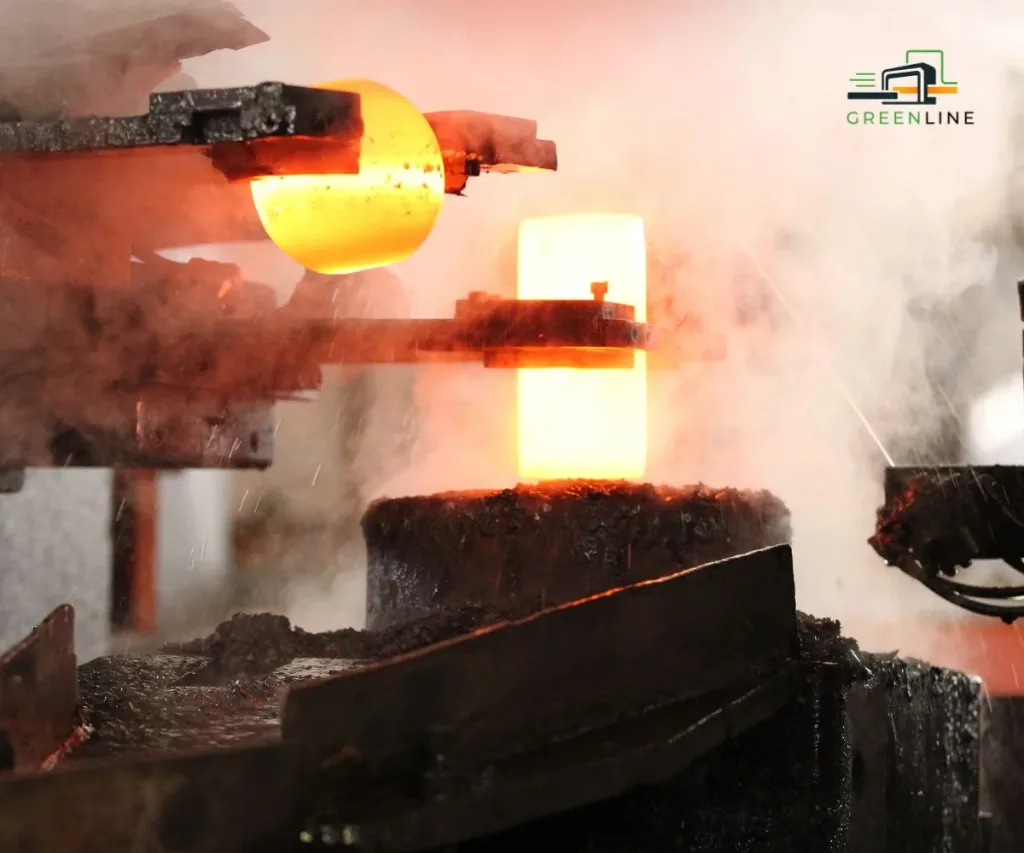
By combining process electrification, innovative ultra-fast cooling technologies, advanced control systems and industrial demonstration, GREENLINE contributes to Europe’s transition towards cleaner, more competitive and more resource-efficient manufacturing. The project focuses on delivering practical solutions capable of supporting the decarbonisation of the forging and casting industries while improving productivity, reducing operational costs and strengthening Europe’s industrial competitiveness.
What is GREENLINE about?
GREENLINE develops an innovative electrified in-line heat treatment process for forged and cast metal components.
Traditional manufacturing separates forming and heat treatment into different production stages. After forging or casting, components cool before entering energy-intensive batch furnaces for reheating and treatment. This interrupts production flow and wastes much of the thermal energy already available in the material.
GREENLINE replaces this approach with an integrated in-line process that combines the residual heat generated during manufacturing with compact electrified furnace technology and an innovative ultra-fast cooling system. By eliminating unnecessary reheating, the project aims to significantly reduce energy demand, shorten production times and lower greenhouse gas emissions while ensuring full compliance with demanding metallurgical standards.
The project also combines intelligent process monitoring, digital modelling and advanced control systems to optimise heat treatment under varying industrial conditions. Together, these technologies will enable a flexible and reliable process that can be integrated into existing production lines with minimal disruption.
To demonstrate its industrial viability, GREENLINE will validate the technology through two large-scale pilot demonstrations covering both forging and casting applications. These demonstrations will provide the evidence needed to support future commercial deployment across Europe’s metal manufacturing sector.
Alongside the technological developments, the project evaluates environmental, economic and industrial impacts to maximise replication potential and accelerate the wider uptake of electrified heat treatment solutions throughout European industry.
EEIP leads the project’s communication, dissemination and exploitation activities. Working closely with the consortium, EEIP will ensure that project results reach manufacturers, technology providers, policymakers, research organisations and other key stakeholders, helping accelerate the adoption of innovative electrified heat treatment technologies across Europe.
Why GREENLINE matters
Industrial heat treatment remains one of the largest sources of energy consumption within the metals manufacturing sector. As Europe moves towards climate neutrality, improving the efficiency of these processes is essential for reducing industrial emissions while maintaining global competitiveness.
GREENLINE demonstrates that decarbonisation does not necessarily require entirely new manufacturing systems. Instead, existing forging and casting processes can be transformed by integrating electrified technologies, recovering valuable residual heat and replacing conventional batch treatment with a more efficient continuous production approach.
By reducing energy consumption, shortening production cycles and lowering CO₂ emissions, the project supports a more sustainable future for Europe’s metal industries. At the same time, it helps strengthen industrial resilience by improving process efficiency, reducing operating costs and supporting the wider transition towards electrified industrial manufacturing.
Through industrial demonstrations, knowledge sharing and collaboration across the value chain, GREENLINE aims to pave the way for broader adoption of electrified heat treatment solutions, contributing to Europe’s ambitions for a competitive, low-carbon and digitally enabled manufacturing sector.
Explore further
GREENLINE has received funding from the European Union’s Horizon Europe Research and Innovation Programme under Grant Agreement No. 101294375. Views and opinions expressed are however those of the author(s) only and do not necessarily reflect those of the European Union or the European Health and Digital Executive Agency (HADEA). Neither the European Union nor the granting authority can be held responsible for them.
