
European industry is under pressure from multiple directions. Manufacturers are expected to remain globally competitive while reducing emissions, improving resource efficiency, strengthening supply chains and adapting to rapidly changing market demands. Traditional production models, built around fixed assets and long-term capacity planning, are increasingly being tested by these new realities.
As Europe accelerates its industrial transition, a new concept is gaining attention: Manufacturing-as-a-Service (MaaS).
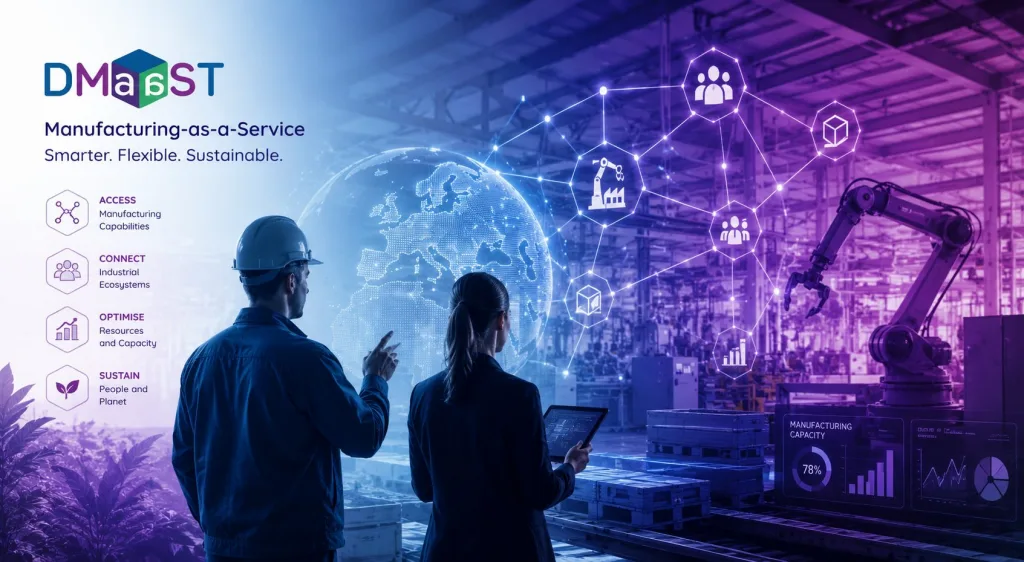
A recent article by Dušan Jakovljević, Communications and Policy Director at EEIP, published on the DMAAST website, explores the growing role of Manufacturing-as-a-Service in Europe’s industrial transition. The article highlights MaaS as a model that can improve flexibility, increase efficiency and support a more sustainable industrial future.
A New Approach to Industrial Capacity
Manufacturing has traditionally been based on ownership. Companies invest heavily in facilities, machinery and production lines to ensure they have the capacity required to meet demand.
While this model has driven industrial growth for decades, it also creates challenges. Production assets are often underutilised, capital investments can be difficult to justify and responding quickly to changing market conditions can be costly.
MaaS offers an alternative approach.
By connecting manufacturers, suppliers and service providers through digital ecosystems, companies can gain access to production capabilities when needed. Instead of building every capability internally, organisations can source manufacturing services from trusted partners within a broader network.
As discussed in the DMAAST article:
“Manufacturing-as-a-Service is not simply a technological evolution. It represents a shift in how manufacturing resources are accessed, shared and utilised.”
This model creates new opportunities for companies of all sizes, particularly SMEs seeking access to specialised manufacturing capabilities without significant upfront investment.
Making Better Use of Existing Resources
One of the strongest arguments for Manufacturing-as-a-Service is its potential contribution to sustainability.
Across Europe, industrial equipment and production facilities often operate below their maximum capacity. At the same time, businesses continue investing in additional assets that may duplicate capabilities already available elsewhere.
Manufacturing-as-a-Service helps address this inefficiency by increasing visibility across industrial networks and facilitating access to existing resources.
Better utilisation of manufacturing assets can lead to:
- Reduced material consumption
- Lower capital expenditure
- Improved energy efficiency
- More efficient use of industrial infrastructure
- Reduced environmental impact
This approach aligns closely with European ambitions for circularity, resource efficiency and industrial decarbonisation.
Rather than continuously expanding production capacity, MaaS encourages smarter and more collaborative use of existing capabilities.
Digitalisation as the Enabler
The success of Manufacturing-as-a-Service depends on more than available production capacity. It requires trusted digital systems capable of matching demand with supply, facilitating collaboration and ensuring transparency across value chains.
Digital technologies make it possible to identify available manufacturing resources, assess capabilities and connect partners that may never have worked together previously.
This creates opportunities for greater agility across industrial ecosystems while reducing barriers to collaboration.
In many ways, Manufacturing-as-a-Service applies platform thinking to industrial production, creating marketplaces and networks that make manufacturing capabilities more accessible and responsive.
DMAAST and the Future of Industrial Collaboration
The DMAAST project is helping transform this concept into a practical reality.
Funded under Horizon Europe, DMAAST is developing the technological frameworks, business models and collaborative approaches needed to support Manufacturing-as-a-Service across European industry. The project explores how manufacturers can access, share and optimise production resources while maintaining competitiveness, resilience and sustainability.
Beyond the technical aspects, DMAAST is also addressing organisational and market challenges that influence the adoption of MaaS, helping ensure that solutions can be implemented in real industrial environments.
As communication partner in the project, EEIP supports the dissemination of project results and contributes to building awareness around the opportunities that Manufacturing-as-a-Service can create for European industry.
Why MaaS matters Now
Manufacturing-as-a-Service is emerging at a moment when European industry needs greater flexibility than ever before.
Geopolitical uncertainty, evolving supply chains, rising resource costs and ambitious climate objectives are all pushing manufacturers to rethink how production is organised. Access to manufacturing capabilities may become just as important as ownership of them.
As noted in the original DMAAST article:
“The future manufacturing landscape will increasingly depend on collaborative networks capable of adapting rapidly to changing market and societal needs.”
MaaS offers a pathway towards that future. By enabling companies to access production capacity more efficiently, improve resource utilisation and strengthen industrial collaboration, it can support a more competitive and sustainable European manufacturing sector.
For industry leaders, policymakers and technology providers alike, the discussion is no longer whether manufacturing will become more connected and service-oriented. The question is how quickly Europe can build the ecosystems needed to make that transformation successful.
Read the full original article by Dušan Jakovljević on the DMAAST website
DMAAST is funded by the European Union under Horizon Europe Grant Agreement No. 101138648.
