
What if the excess heat from one factory could supply another? Or a material currently treated as waste could replace virgin raw material in a neighbouring production process?
This is the basic idea behind industrial symbiosis: connecting organisations so that materials, energy, water, by-products, infrastructure and other resources can be used more efficiently across company boundaries.
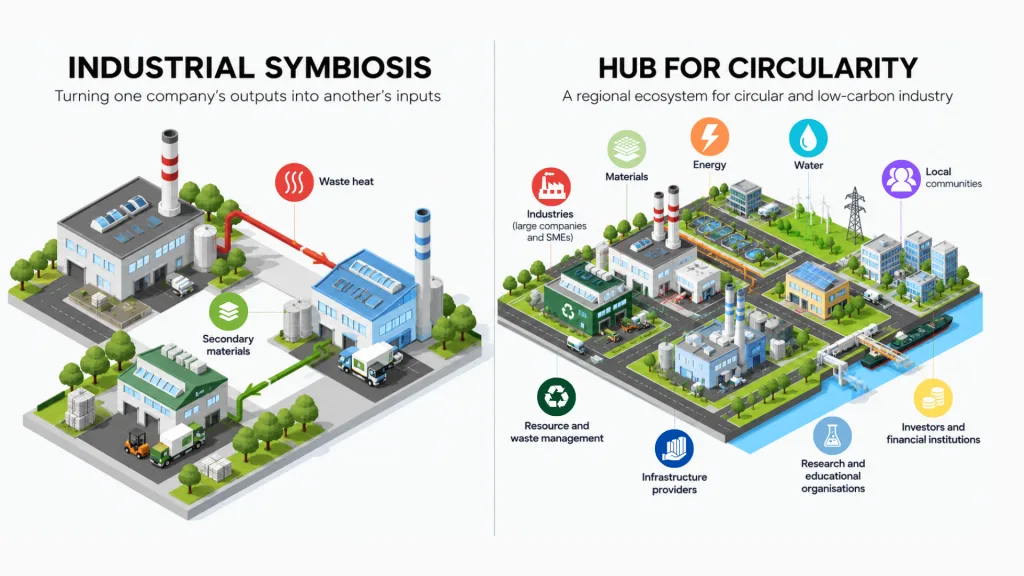
Hubs for Circularity (H4C) take this principle further. Instead of creating individual exchanges between companies, they aim to build regional ecosystems in which industries, public authorities, technology providers, researchers and other stakeholders cooperate to improve resource circularity and reduce emissions at a much larger scale.
The concept has become part of the European approach to transforming energy-intensive and process industries. But what actually distinguishes a Hub for Circularity from industrial symbiosis, and what does it take to make one work?
What is industrial symbiosis?
Industrial symbiosis is cooperation between organisations in which underused resources from one activity become useful inputs or resources for another. These can include materials, industrial by-products, energy, waste heat, water, infrastructure, capacity and expertise.
The European Commission describes industrial symbiosis as a systems approach that identifies business opportunities based on underused resources. The participating organisations can operate in different sectors but create mutually beneficial relationships by exchanging or sharing resources.
A simple example would be a factory producing excess heat that it cannot use itself. A nearby company requires heat for its production process. Connecting the two can turn an otherwise wasted energy stream into a useful resource.
The same principle can apply to:
- industrial by-products replacing primary raw materials;
- treated process water being reused by another facility;
- shared renewable energy, storage or utility infrastructure;
- captured CO₂ becoming an input to another industrial process;
- shared logistics, treatment or storage facilities.
Industrial symbiosis therefore looks beyond the efficiency of a single factory. It asks whether resources can be used more effectively across an industrial network.
This also makes it an important part of the circular economy. Instead of resources moving through a linear system from extraction to production and eventually disposal, industrial symbiosis creates additional loops between organisations and sectors.
What is a Hub for Circularity?
A Hub for Circularity, or H4C, is a regional industrial ecosystem that implements industrial and industrial-urban symbiosis at scale, combining circular technologies with infrastructure, business models, governance and cooperation between different regional stakeholders.
The European Commission introduced H4C within its research and innovation approach for the transformation of European process industries. H4C are intended to demonstrate a significant improvement in the circular use of resources such as feedstock, energy and water while contributing to greenhouse gas emission reductions and remaining economically viable.
A Hub for Circularity can involve considerably more than factories exchanging waste streams. Its ecosystem may include:
- large industrial companies and SMEs;
- local and regional authorities;
- utilities and infrastructure operators;
- waste and resource management organisations;
- universities and research organisations;
- technology providers;
- investors;
- local communities and civil society.
This wider regional perspective is important because industrial activity is connected to its surroundings.
Energy networks, water systems, transport infrastructure, waste management, workforce, land use and supply chains rarely stop at the factory gate. H4C attempts to address these connections as part of one industrial transition.
Industrial symbiosis vs Hubs for Circularity: what is the difference?
Industrial symbiosis is the mechanism through which organisations share or exchange resources. A Hub for Circularity creates a wider ecosystem in which multiple symbioses, technologies and stakeholders can operate together at regional scale.
A single industrial symbiosis might connect two companies through a waste heat pipeline.
A Hub for Circularity could include that heat exchange alongside water reuse, secondary material flows, renewable energy infrastructure, carbon capture and utilisation, shared digital systems and cooperation with regional authorities.
| Industrial symbiosis | Hub for Circularity |
|---|---|
| Can involve two or more organisations | Involves a wider regional ecosystem |
| Often starts with a particular resource opportunity | Connects multiple circular opportunities |
| Focuses on resource sharing and exchange | Combines symbiosis with infrastructure, governance and innovation |
| Can exist at relatively small scale | Designed for industrial and regional scale |
| Mainly concerns participating organisations | Can connect industry with cities, authorities, research and communities |
Industrial symbiosis is therefore not an alternative to H4C. It is one of its foundations.
How does industrial symbiosis work in practice?
The idea of turning one company’s output into another company’s input sounds simple. Implementation is considerably more complicated.
It usually starts with understanding what resources are available and what resources are needed across an industrial area.
This can include mapping:
Materials: secondary raw materials, industrial residues, slags, minerals, metals, biomass and chemical streams.
Energy: electricity, steam, excess process heat and other recoverable energy.
Water: process water, treated wastewater and different qualities of water suitable for reuse.
Gases: hydrogen, oxygen, captured CO₂ and other industrial gases.
Infrastructure and services: pipelines, storage, treatment facilities, logistics, utilities and specialist services.
Once a possible match has been identified, the organisations still need to determine whether it makes sense.
Is the resource technically suitable? Does it require treatment? How far does it need to travel? Is supply reliable enough for another company to depend on it? What infrastructure is required? Who pays for that infrastructure? What regulations apply?
Only after the technical, environmental and economic case works can a potential resource match become a functioning industrial symbiosis.
This explains why industrial symbiosis is not simply a waste-matching exercise. It creates long-term relationships between organisations that may previously have operated independently.
Why does this matter for industrial decarbonisation?
Industrial decarbonisation is often discussed in terms of technologies installed within individual plants: electrification, renewable energy, energy efficiency, carbon capture or hydrogen.
Those technologies are essential, but some decarbonisation opportunities only become possible when companies cooperate.
Waste heat needs a user. Shared hydrogen infrastructure needs sufficient coordinated demand. Secondary materials need reliable suppliers and customers. Carbon capture and utilisation requires connections between sources of CO₂ and potential users.
Industrial symbiosis can therefore help reduce demand for primary resources, recover energy that would otherwise be lost and enable infrastructure that may be difficult for individual companies to develop alone.
The European Commission’s research into industrial symbiosis has identified significant potential for reducing emissions, freshwater consumption and industrial costs, although the actual benefit of any individual symbiosis depends on its specific circumstances.
The H4C approach adds another layer: instead of optimising these opportunities one company at a time, it considers how they interact across an entire industrial region.

What stops industrial symbiosis from happening?
The biggest misconception about industrial symbiosis is that finding a technically possible resource exchange is enough.
It isn’t.
A company may discover that another factory five kilometres away could use its excess heat, but connecting them could require a pipeline, permits, long-term contracts and substantial investment. Both companies also need confidence that the other will still be operating and requiring the resource years into the future.
Common barriers include:
Lack of information. Companies may not know what resources other organisations in their region produce or need.
Commercial confidentiality. Sharing detailed information about energy and material flows can reveal sensitive information about production.
Infrastructure costs. Pipelines, treatment systems, storage and other connections can require significant investment.
Uncertain supply and demand. Companies need to know that a resource will remain available, and that someone will continue to use it.
Regulation. Waste classification, permitting and liability rules can affect whether materials can be transferred and reused.
Different investment cycles. Two companies may identify an excellent opportunity but be unable to invest at the same time.
Coordination and trust. Industrial symbiosis creates relationships between organisations with different priorities, business models and risk profiles.
Recent European initiatives continue to identify fragmentation, cross-sector coordination and standardisation as barriers to wider industrial symbiosis deployment.
This is also where the difference between individual industrial symbiosis and a functioning H4C becomes particularly important.
What does a successful Hub for Circularity need?
Technology alone does not create a Hub for Circularity. A functioning H4C needs viable resource opportunities, enabling infrastructure, business cases, governance, data and long-term cooperation between stakeholders.
In practice, several elements need to develop together.
1. Resource opportunities
The region needs to understand where materials, energy, water and other resources are produced and consumed, and where useful connections could exist.
2. Technically viable solutions
Potential exchanges must be supported by technologies capable of recovering, treating, transporting, storing or converting the relevant resources.
3. A business case
Circularity still needs to work economically. Investment costs, operating costs, resource prices, contracts and risks determine whether companies can participate over the long term.
4. Infrastructure
Many symbioses require physical connections such as pipelines, energy networks, storage facilities or treatment systems.
5. Data and digital tools
Industrial regions contain large numbers of interconnected resource flows. Digital platforms can help map supply and demand, identify possible synergies, model scenarios and support collaboration.
6. Governance
Someone needs to coordinate the ecosystem. Questions around ownership, responsibilities, access, investment and risk cannot always be solved by individual companies negotiating separately.
7. Stakeholder cooperation
Authorities, companies, researchers, infrastructure operators, technology providers and communities may all influence whether a solution can be implemented.
This combination makes H4C a socio-technical transition rather than simply an engineering project.
Research emerging from European H4C initiatives reflects this complexity. For example, work from the IS2H4C project has examined stakeholder engagement and critical success factors alongside optimisation of resource flows, showing that both the physical network and the relationships between its participants matter.
What role do digital tools play?
Digitalisation can make complex industrial ecosystems easier to understand and coordinate.
A large industrial region may contain hundreds of organisations producing and consuming many different resources. Identifying useful combinations manually becomes increasingly difficult as the network grows.
Digital tools can support:
- mapping resource supply and demand;
- identifying potential symbiosis partners;
- modelling material and energy flows;
- comparing alternative scenarios;
- monitoring environmental and economic performance;
- sharing information between participating organisations.
But digitalisation does not remove the human side of industrial symbiosis.
A platform might identify that Company A produces exactly the resource Company B requires. It cannot by itself decide who should finance the connection, resolve regulatory questions or convince either company to accept a long-term commercial dependency.
Digital tools can reveal opportunities. Cooperation turns them into projects.
Hubs for Circularity in practice: IS2H4C
Europe is now testing how the H4C concept can work in existing industrial regions.
One of these initiatives is IS2H4C: Sustainable Circular Economy Transition: From Industrial Symbiosis to Hubs for Circularity, a Horizon Europe project coordinated by the University of Twente.
The project is developing and demonstrating H4C approaches across four industrial regions in the Netherlands, Germany, Spain and Türkiye. Rather than focusing only on individual technologies, IS2H4C combines technology and infrastructure integration with research into societal, governmental and business innovation.
Its four demonstration environments are:
- Almelo & H2Hub Twente in the Netherlands;
- Industriepark Höchst in Germany;
- the Basque Country in Spain;
- Izmir-Manisa in Türkiye.
This variety is important. There is unlikely to be one universal blueprint for creating a Hub for Circularity. Existing industries, infrastructure, resources, geography and stakeholder relationships differ from region to region.
IS2H4C therefore addresses a question that matters beyond the individual demonstration sites: how can existing industrial areas move from isolated resource exchanges towards scalable and replicable circular ecosystems?
The project is also developing digital approaches for resource and information sharing and has produced research on stakeholder engagement and resource-flow optimisation.
EEIP is a project partner and leads the project’s communication, dissemination and exploitation activities, helping connect the knowledge generated by the project with industrial stakeholders and the wider H4C community.
Frequently asked questions
Is industrial symbiosis part of the circular economy?
Yes. Industrial symbiosis is one way of implementing circular economy principles across organisations. It keeps materials, energy, water and other resources in productive use by creating connections between processes that would otherwise operate separately.
Do companies need to be located next to each other?
Not necessarily, but distance matters. Transporting low-value or high-volume materials over long distances may undermine the economic or environmental benefit. Waste heat and pipeline-based exchanges are particularly dependent on geography and infrastructure.
Can SMEs participate in Hubs for Circularity?
Yes. The European H4C concept explicitly includes SMEs alongside larger industries, authorities, research and educational organisations and civil society. SMEs can participate as resource providers or users, technology suppliers, service providers and other actors within circular value chains.
What is the difference between an eco-industrial park and a Hub for Circularity?
The concepts overlap, particularly in their emphasis on cooperation and resource efficiency. H4C, as developed within the European research and innovation framework, specifically emphasises industrial and industrial-urban symbiosis at significant scale, alongside circular technologies, regional stakeholder participation and progress towards circularity and climate neutrality.
What makes industrial symbiosis economically viable?
There is no single formula. Viability depends on the value of the exchanged resource, avoided material or disposal costs, infrastructure investment, transport distance, reliability of supply and demand, regulation, contracts and the expected lifetime of the cooperation.
From efficient factories to connected industrial regions
Improving efficiency within individual factories remains essential to industrial decarbonisation. But the factory gate is not necessarily where optimisation should end.
A company’s excess heat may be another company’s energy source. A by-product may become a secondary raw material. Water may be reused across processes. Infrastructure may become more viable when several organisations share it.
Industrial symbiosis creates these connections. Hubs for Circularity ask how they can become part of a functioning regional system.
That shift introduces complexity. Technology must work alongside viable business models, infrastructure, regulation, digital tools, governance and stakeholder cooperation.
It also creates an opportunity. Instead of treating industrial sites as isolated consumers of energy and materials, H4C approaches them as interconnected parts of a regional resource system.
Projects such as IS2H4C are now testing what it takes to make that transition work under real industrial conditions. The lessons emerging from these regions can help determine whether industrial symbiosis remains a collection of individual success stories or develops into something much larger: a practical model for more circular and resilient European industry.
