
Improving energy efficiency in the agri-food sector requires more than individual investments. It depends on cooperation between companies, regional stakeholders and public authorities to identify common challenges and develop practical solutions that can be implemented across entire value chains.
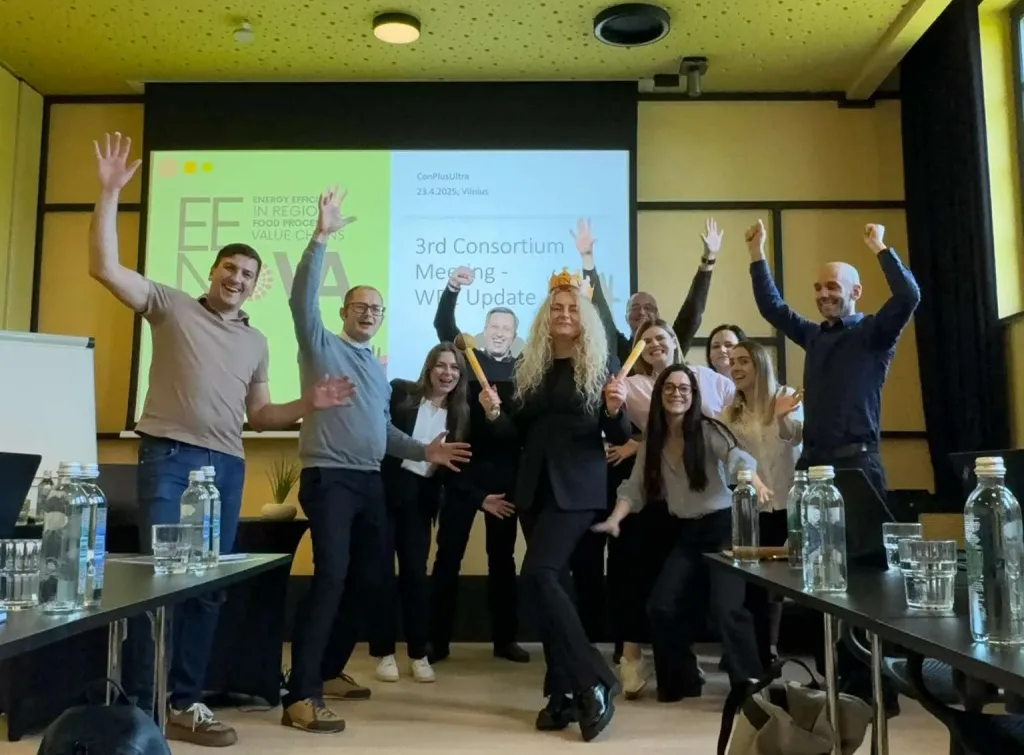
This collaborative approach was at the centre of the EENOVA consortium meeting, held in Vilnius, Lithuania, and hosted by AgriFood Lithuania DIH. Bringing together partners from across Europe, the meeting marked an important transition in the project as activities move from planning and analysis towards implementation across the five regional pilot areas.
Building on Strong Foundations
Over two days, consortium partners reviewed progress across all work packages and confirmed that the project has successfully completed the groundwork needed to enter its next phase.
The discussions focused on consolidating technical findings, regional experiences and stakeholder input gathered during the first stages of the project. These activities have created a strong basis for supporting energy efficiency improvements within food processing value chains while ensuring that regional actions contribute to the project’s wider European objectives.
Partners also reviewed upcoming deliverables and coordinated activities across the consortium to maintain consistency between technical work, stakeholder engagement and policy development.
Turning Dialogue into Practical Action
A key milestone discussed during the meeting was the launch of the third round of regional EENOVA roundtables.
Unlike conventional workshops, the EENOVA roundtables follow a structured methodology that gradually moves stakeholders from identifying common challenges to developing realistic implementation pathways. Earlier discussions focused on understanding regional conditions and defining priorities, while the third round shifts attention towards practical actions that companies and value chain partners can begin putting into practice.
By bringing together food producers, business associations, public authorities and technical experts, the roundtables encourage collaborative decision-making that reflects the needs of entire regional ecosystems rather than individual organisations.
This approach strengthens the project’s potential to deliver solutions that are both technically feasible and widely transferable across Europe’s agri-food sector.
Learning Across Regions
An important part of the Vilnius meeting focused on sharing experiences between the project’s five pilot regions.
Although each region faces different industrial structures, policy frameworks and energy challenges, many of the barriers affecting SMEs are remarkably similar. Partners discussed how lessons learned in one pilot could inform activities elsewhere, helping improve consistency while increasing the project’s replication potential.
This exchange of experience is one of EENOVA’s greatest strengths. Rather than developing isolated regional solutions, the project creates opportunities for partners to build on each other’s knowledge and accelerate progress through continuous collaboration.
Supporting Visibility and Stakeholder Engagement
As leader of the project’s communication, dissemination and stakeholder engagement activities, EEIP participated in discussions on how the next phase of EENOVA should be communicated to industry, policymakers and the wider energy efficiency community.
With implementation activities now beginning across the pilot regions, communication becomes increasingly important for sharing practical experiences, encouraging stakeholder participation and ensuring that project results reach organisations interested in improving energy efficiency within the agri-food sector.
Throughout the meeting, partners also aligned future dissemination activities, communication priorities and outreach opportunities to support greater visibility of the project’s achievements as new results emerge.
Preparing for the Next Phase
The Vilnius consortium meeting confirmed that EENOVA is entering one of its most significant stages.
With the third round of regional roundtables ready to begin, attention is shifting from analysing challenges towards implementing solutions that can improve energy efficiency, strengthen regional cooperation and increase the competitiveness of Europe’s agri-food sector.
EEIP will continue supporting this process by promoting project activities, sharing good practices and helping communicate results that demonstrate how collaborative approaches can accelerate the transition towards more sustainable and energy-efficient food production.
Learn More About EENOVA
EENOVA supports small and medium-sized enterprises in the agri-food sector by improving energy efficiency through regional cooperation, stakeholder engagement and practical decarbonisation strategies.
Discover the latest project news, regional pilot activities and upcoming events on the official website:
Funding Acknowledgement
This project has received funding from the European Union’s LIFE Programme under Grant Agreement No. 101119476.
Views and opinions expressed are however those of the author(s) only and do not necessarily reflect those of the European Union or the European Climate, Infrastructure and Environment Executive Agency (CINEA). Neither the European Union nor the granting authority can be held responsible for them.
