
How can successful industrial symbiosis initiatives move beyond individual demonstration sites and inspire wider adoption across Europe?
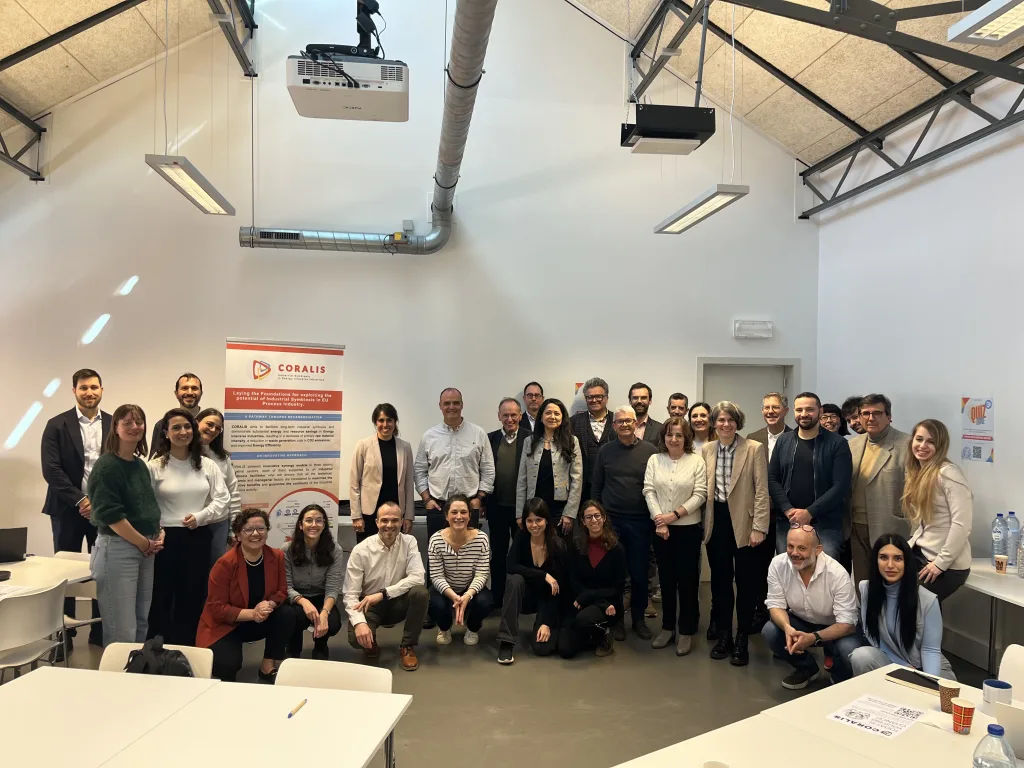
This question shaped the CORALIS Final Conference, organised and hosted by EEIP in Brussels on 19 March 2025. The event brought together project partners, representatives from the European Commission, industry leaders, researchers and circular economy stakeholders to explore how the project’s results can continue creating impact beyond its official lifetime.
Held immediately after the consortium’s final General Assembly, the conference transformed four years of research, demonstration and collaboration into a public discussion on the future of industrial symbiosis in Europe.
From Demonstration Sites to Replicable Solutions
Throughout the conference, partners presented the technical and operational achievements developed across the CORALIS demonstration hubs in Escombreras (Spain), Brescia (Italy) and Frövi (Sweden), together with experiences from the project’s follower regions.
Rather than focusing solely on individual technologies, presentations highlighted how industrial symbiosis creates value by connecting companies, resources and infrastructure within regional industrial ecosystems. Participants explored how waste streams, excess heat, by-products and shared services can become valuable resources through cooperation between neighbouring industries.
These practical examples demonstrated that industrial symbiosis is not only an environmental concept but also a pathway towards greater resource efficiency, competitiveness and resilience for European industry.
Beyond Technology: Creating the Right Conditions
A recurring message throughout the event was that technology alone is not enough to establish successful industrial symbiosis.
Dedicated sessions explored the financial, regulatory and organisational conditions needed to support collaboration between companies. Speakers discussed business models, contractual arrangements, investment opportunities and governance approaches that help industrial symbiosis initiatives move from pilot projects to long-term implementation.
Interactive discussions with participants reinforced the importance of combining technical innovation with supportive policy frameworks and effective stakeholder engagement to accelerate the transition towards more circular industrial systems.
EEIP Connecting Results with European Stakeholders
As the leader of communication, dissemination and stakeholder engagement within CORALIS, EEIP was responsible for designing and delivering the final conference programme, coordinating speakers and ensuring that the project’s achievements reached audiences beyond the consortium.
Bringing together representatives from European institutions, industry associations, research organisations and related Horizon projects created valuable opportunities for dialogue, knowledge exchange and future collaboration. The conference also reinforced links with wider European initiatives working on industrial decarbonisation, circular economy and industrial symbiosis.
Throughout the project, EEIP has supported CORALIS through strategic communication, stakeholder engagement, digital dissemination and event organisation, helping ensure that project results remain visible and accessible to organisations interested in implementing industrial symbiosis approaches.
Continuing the CORALIS Legacy
The conference concluded with a high-level roundtable discussing how CORALIS results can continue supporting industrial transformation after the project’s completion.
Representatives from the European Commission, sister projects, industry and organisations including A.SPIRE explored opportunities for replication, investment and future collaboration, highlighting the growing importance of industrial symbiosis within Europe’s industrial strategy.
While the project itself has formally concluded, the knowledge, partnerships and practical experience developed through CORALIS continue to provide valuable foundations for future initiatives that seek to improve resource efficiency and strengthen the competitiveness of European industry.
Learn More About CORALIS
CORALIS developed innovative industrial symbiosis solutions that help industrial regions improve resource efficiency, reduce emissions and create more circular value chains through collaboration between companies.
Discover the project’s demonstration activities, publications and final results on the official website: https://coralis-h2020.eu
Funding Acknowledgement
This project has received funding from the European Union’s Horizon 2020 research and innovation programme under Grant Agreement No. 958337.
Views and opinions expressed are however those of the author(s) only and do not necessarily reflect those of the European Union or the granting authority. Neither the European Union nor the granting authority can be held responsible for them.
