
Industrial motor systems are among the largest consumers of electricity in European industry, yet many of their potential efficiency improvements remain overlooked. The hidden energy savings are not necessarily found in replacing old motors with newer models, but in understanding how pumps, fans, compressors and other motor-driven equipment operate as complete systems. Better controls, appropriate equipment sizing and more informed maintenance decisions can often make a substantial difference, provided that companies know where to look.
This was the central message of Rod Janssen, President of Energy Efficiency in Industrial Processes (EEIP), during his presentation at the International Symposium on Energy Management and Sustainability (ISEMAS 2026). The conference took place online from Istanbul, Türkiye, on 7–9 October 2026, bringing together researchers and energy professionals to discuss sustainable energy management. Speaking as an invited expert on 8 October, Rod presented Electric Motors: Turning Audits into Energy Savings, exploring why industrial energy audits frequently miss important opportunities and how companies can turn technical assessments into practical improvements.
Why Industrial Motor Efficiency Is About More Than the Motor
Electric motors are fundamental to industrial production. They move materials, circulate liquids, compress air, provide ventilation and support countless processes that would otherwise come to a standstill. Their widespread use also makes them a major factor in industrial energy consumption. Figures presented by Rod indicate that motor-driven systems account for approximately 56% of EU electricity use and around 70% of industrial electricity consumption. With an estimated 380 million motors installed across the EU in 2020, even relatively modest improvements could have a considerable cumulative impact.
However, focusing exclusively on the efficiency rating of an individual motor can lead businesses to overlook more valuable opportunities elsewhere in the system. A highly efficient motor connected to an oversized pump, for example, may still consume more electricity than necessary. Similarly, equipment operating continuously at a fixed speed may waste energy when actual production requirements fluctuate throughout the day. In such cases, replacing the motor alone does little to address the underlying problem.
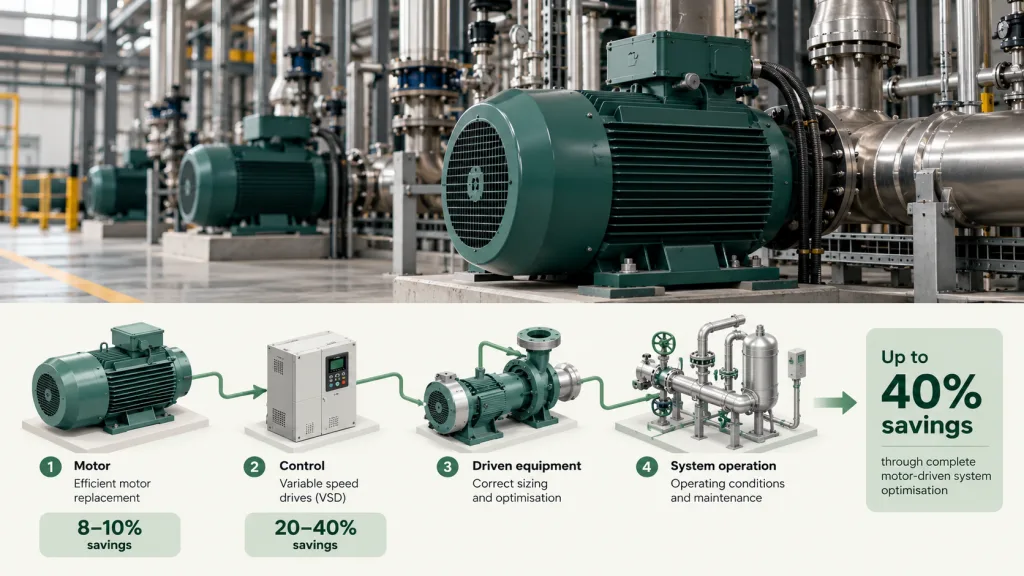
The potential difference between individual equipment upgrades and system-wide improvements is significant. According to the indicative figures shared during the presentation, motor replacements can deliver energy savings of approximately 8–10%, while variable speed drives may reduce consumption by 20–40% in suitable applications. Optimising an entire motor-driven system, including equipment sizing, controls and operating conditions, can reveal savings opportunities of up to around 40%, depending on the installation.
These examples highlight why industrial energy efficiency requires a broader perspective. Rather than asking whether a motor is efficient, companies need to understand whether the entire system is performing the required task with the least practical amount of energy. That distinction is essential for identifying the most effective investments.
The Energy Audit Paradox: Why Opportunities Remain Undetected
Given the importance of motor-driven systems, it might seem reasonable to assume that they receive considerable attention during industrial energy audits. Rod’s presentation challenged this assumption by highlighting what he described as the energy audit paradox: although motors dominate industrial electricity consumption, they are frequently assessed only superficially during mandatory audits.
The problem often begins with how audits are commissioned and conducted. When the primary objective is to demonstrate regulatory compliance at the lowest possible cost, there may be insufficient time or resources for detailed measurements, load-profile analysis or modelling alternative system configurations. Auditors can identify a large electricity consumer without investigating whether the equipment is correctly sized, appropriately controlled or operating efficiently under real production conditions.
Rod illustrated this challenge with experience from Denmark, where reviewed audit samples showed virtually no detailed analysis of motor-driven systems. This suggests that the existence of audit obligations does not automatically guarantee the identification of meaningful savings opportunities. The quality and technical depth of the assessment are equally important.
The consequences extend beyond the technical findings. General recommendations such as replacing inefficient equipment may offer little guidance on investment priorities, implementation costs or expected financial returns. Without sufficiently detailed information, companies can struggle to justify improvements internally or present convincing projects to potential financiers.
This is where many of the hidden energy savings remain untapped. A more effective audit would examine complete systems, including pumps, fans, compressors, operating patterns and control strategies. It would also compare possible interventions and translate the findings into a practical investment plan, allowing companies to understand not only what could be improved, but how and when to act.
From Reactive Replacement to Continuous Energy Management
Another important theme of the presentation was the relationship between energy efficiency and everyday industrial maintenance. Motors often remain in service for many years, and replacement decisions are frequently made only when equipment fails. Under pressure to resume production, maintenance teams may choose a similar replacement without questioning whether the original motor was appropriately sized or whether the wider system could be improved.
While understandable from an operational perspective, this approach can lock unnecessary energy consumption into production processes for another equipment cycle. Rod therefore argued that motor-system optimisation should be integrated into continuous energy management rather than treated as an occasional activity triggered by equipment failure or mandatory audits.
The starting point is a reliable inventory of critical motor-driven systems, identifying their functions, operating hours and importance to production. Companies can then measure actual loads, flows and control conditions to understand how equipment performs in practice. This information helps reveal opportunities for right-sizing, improved speed control, changes to operating practices and planned equipment replacement.
Preparing replacement strategies before equipment fails is particularly valuable. It gives businesses time to evaluate different technical solutions, compare lifecycle costs and coordinate investments with maintenance schedules. Once improvements are implemented, ongoing performance monitoring can help verify whether the expected savings are achieved and whether further adjustments are needed.
This approach also changes how companies think about efficiency investments. Instead of viewing them as isolated equipment purchases, businesses can incorporate system performance into long-term operational planning. Energy management then becomes a tool for controlling costs, improving reliability and supporting industrial competitiveness.
Technical Expertise: The Missing Link Between Audits and Action
Efficient motors, variable speed drives and digital monitoring technologies are already commercially available. Yet their availability does not guarantee that companies will identify or implement the most appropriate solutions. A recurring barrier is the shortage of professionals with the practical expertise needed to evaluate complete motor-driven systems.
Assessing a motor in isolation requires a different skill set from analysing the interaction between a motor, its driven equipment and the wider production process. Meaningful system assessments depend on understanding operating conditions, interpreting measurements and modelling how different technical interventions would affect performance. Without these capabilities, even well-intentioned audits can produce recommendations that overlook the most valuable improvements.
Rod’s presentation therefore emphasised the importance of strengthening professional training. One proposed approach was a specialised practical programme lasting approximately three to four days, potentially supported by examination or certification. The objective would be to equip auditors and SME energy consultants with the skills needed to conduct more useful system-level assessments.
Examples from Switzerland, Türkiye and Denmark illustrated different ways of developing these capabilities. Switzerland’s TopMotors initiative has supported practical knowledge of motor-system efficiency, while Türkiye has introduced structured training and examination requirements linked to audit permissions. Denmark offers experience with advanced technical modelling, although Rod noted that stronger policy incentives may still be needed to encourage its widespread application.
Importantly, better expertise is not only a concern for auditors. Motor suppliers, distributors, maintenance contractors and procurement professionals also influence the choices businesses make. Improving knowledge throughout this chain could help prevent inefficient like-for-like replacements and encourage decisions based on long-term system performance.
Turning Industrial Energy Audits into Investable Projects
Identifying a technically attractive efficiency measure is only the beginning. For an industrial company to proceed, it must also understand the likely costs, operational implications, financial benefits and implementation requirements. Rod therefore connected the need for better audits with a wider discussion about investment support and cooperation between industrial stakeholders.
Rather than relying on entirely new financing mechanisms, the presentation suggested making better use of existing European and national instruments while strengthening the technical preparation of projects. More detailed system assessments could help businesses develop credible investment proposals, estimate expected returns and prioritise measures according to their potential impact.
Achieving this requires cooperation among policymakers, national authorities, equipment manufacturers, industrial users, energy service companies, digital technology providers and financial institutions. Suppliers and technical specialists can help identify appropriate solutions, while policymakers and financing organisations can support the conditions needed for wider implementation. Aggregated procurement and coordinated investment programmes could also make certain improvements more accessible, particularly for smaller industrial companies.
As an illustrative ambition, Rod proposed that a coordinated initiative could work towards reducing electricity consumption from motor-driven systems by 25–30% by 2035 through modern motors, variable speed drives and comprehensive system optimisation. This was presented as a potential target for collective action rather than an established European policy commitment.
The underlying argument is that technical capability and financing need to be connected. Companies are more likely to invest when they receive reliable information about expected savings, implementation costs and operational benefits. Improving this connection can help ensure that valuable audit findings do not remain recommendations on paper.
Making the Hidden Energy Savings a Practical Industrial Priority
Rod Janssen’s contribution to ISEMAS 2026 offered a reminder that industrial decarbonisation does not always depend on developing entirely new technologies. Many opportunities already exist within the equipment and processes that European companies use every day. Realising them requires a more systematic understanding of how those systems operate, supported by skilled professionals and investment decisions that consider long-term performance.
For EEIP, this discussion reflects a wider priority: bringing together technical expertise, industrial stakeholders and practical approaches that make energy efficiency improvements achievable. Better audits can reveal opportunities, but meaningful progress depends on translating those findings into operational changes, well-prepared investments and measurable results.
The central takeaway from the presentation was that Europe does not lack efficient motors or technologies capable of reducing electricity consumption. The greater challenge is developing the energy management practices and technical capabilities needed to identify the right interventions before inefficient decisions become embedded in industrial operations.
By looking beyond individual motors and examining the systems they serve, European industry can turn overlooked efficiency opportunities into lower operating costs, more resilient production and lasting reductions in energy demand.
