
EEIP joins a new Horizon Europe initiative bringing together cities, researchers and innovation specialists to make building renovation more efficient through advanced scanning technologies, artificial intelligence and Digital Twins.
The scan2twin project officially began on 1 October 2026, marking the start of a new European collaboration to tackle one of the persistent challenges in building renovation: the lack of accurate and accessible information about existing buildings. Funded by the European Union’s Horizon Europe programme, the project aims to develop and validate affordable scanning services capable of generating reliable Building Information Models (BIM) and Digital Twins. Energy Efficiency in Industrial Processes (EEIP) is part of the consortium, contributing its experience in European innovation projects and connecting innovative solutions with the stakeholders who can put them into practice.
Why the scan2twin project matters for building renovation
Renovating an existing building begins with understanding what is already there. Yet building plans are often incomplete, outdated or inconsistent with the actual structure. Hidden construction elements, insufficient technical documentation and lengthy on-site surveys can complicate renovation decisions before work even begins. These uncertainties affect more than the technical design. They can delay projects, increase costs and make it harder for building owners, municipalities and investors to assess which interventions will deliver the greatest benefits. scan2twin aims to address these challenges by making detailed building information easier, faster and more affordable to obtain.
The project will explore how automated scanning technologies, artificial intelligence and data integration can transform information collected from existing buildings into accurate digital representations. A Building Information Model provides a structured representation of a building’s physical and functional characteristics. A Digital Twin can build on this information to support analysis, planning and building management. By improving the quality of information available at the planning stage, scan2twin aims to help cities evaluate renovation options more confidently, reduce uncertainty and make better-informed investment decisions.
Kick-off meeting in Bonn: turning a shared ambition into action
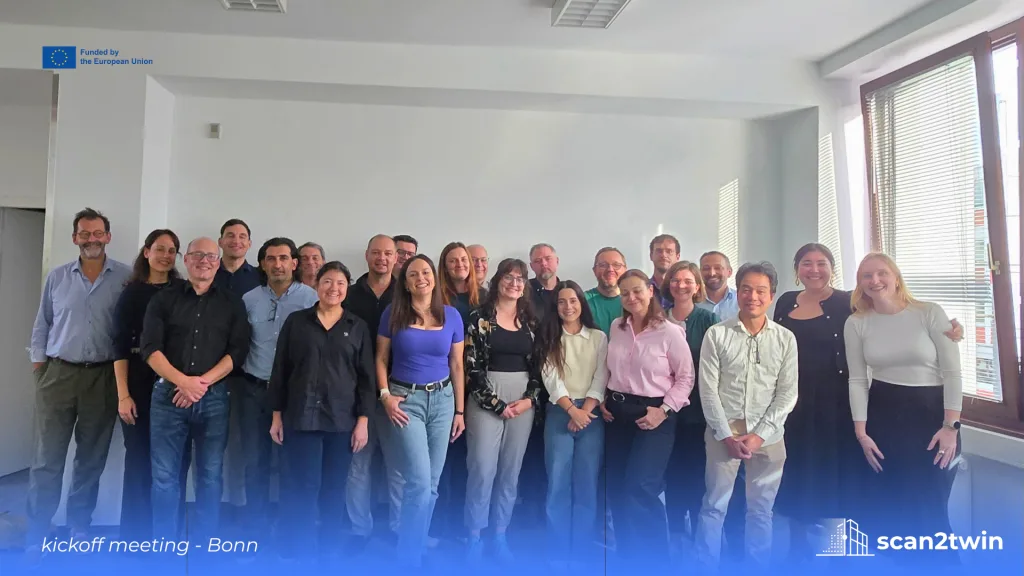
On 7 and 8 October 2026, the scan2twin consortium gathered in Bonn, Germany, for its official kick-off meeting (KOM), shortly after the project began. Coordinated by the German research and consultancy organisation empirica, scan2twin brings together public authorities, research organisations and innovation specialists from across Europe. The Bonn meeting marked an important starting point for the collaboration, bringing partners together around the project’s objectives, implementation approach and the work ahead.
A central element of scan2twin is its use of Pre-Commercial Procurement (PCP), an approach through which public procurers can encourage the research and development of innovative solutions that are not yet sufficiently available on the market. A Buyers Group involving public procurers from the Netherlands, Germany, Poland, Portugal, Slovenia and Türkiye will work together to address common building renovation needs. Rather than relying solely on existing commercial services, this approach will enable the participating authorities to stimulate, assess and validate technological solutions designed around their practical requirements.
The kick-off in Bonn therefore represented more than the formal launch of a European project. It marked the beginning of a joint effort to connect real municipal renovation challenges with technological innovation.
EEIP’s participation: connecting innovation with practical impact
As a consortium partner, Energy Efficiency in Industrial Processes (EEIP) brings experience in stakeholder engagement, communication, dissemination and the market uptake of European innovation. Although EEIP’s work spans different areas of the energy transition, its involvement in scan2twin reflects a broader objective: helping promising technologies move beyond research and towards practical application.
Developing an effective technological solution is only part of the challenge. Its wider adoption also depends on whether potential users understand its benefits, whether services respond to market needs and whether relevant stakeholders can identify opportunities for implementation. These considerations are especially important in a project such as scan2twin, where technological development must respond to the needs of public authorities and the wider building renovation sector.
EEIP’s participation provides an opportunity to contribute its communication and stakeholder-oriented expertise while supporting the project’s wider visibility and potential for uptake. Through its experience in European collaborative initiatives, EEIP works to connect research, industry, policymakers and other relevant actors. This perspective complements scan2twin’s ambition to make innovative building scanning services accessible and relevant beyond the initial participating cities.
Discover more about EEIP’s involvement in European-funded projects and its services supporting innovation and market development.
From building scans to reliable Digital Twins
The technological ambition of scan2twin goes beyond producing digital images or conventional building surveys. The project aims to stimulate the development of services combining automated, multimodal scanning technologies with AI-driven data processing. These technologies should be capable of collecting information about existing buildings, including elements that are difficult to assess through conventional methods.
The collected measurements will be combined with existing documentation to develop quality-assured BIM models and Digital Twins. Importantly, the ambition is not simply to create detailed digital representations. The resulting information should help cities explore renovation scenarios, assess financing options and prepare projects with greater confidence.
Affordability and scalability will be essential. Solutions must balance technical accuracy with practical considerations such as cost, survey time and disruption to building occupants.
The project also foresees training and guidance to help municipal staff use the developed services effectively.
What scan2twin aims to achieve by 2030
Over its planned implementation period, ending on 31 January 2030, scan2twin will work towards turning these technological ambitions into services that can be tested and assessed against real public-sector needs. The expected outputs include validated BIM and Digital Twin assets, renovation and financing scenario reports, and practical guidance to support future procurement and deployment.
A further priority is replication. Through its planned Follower Network and cooperation with the EU Cities Mission ecosystem, the project aims to extend the relevance of its results to other cities interested in modernising their building stock. If the proposed solutions prove sufficiently accurate, affordable and practical, they could help municipalities prepare renovation projects more efficiently, improve investment planning and support reductions in greenhouse gas emissions.
For EEIP, participation in scan2twin represents an opportunity to contribute to a European initiative that connects digital innovation with the practical demands of the energy transition. The work that began in Bonn is the starting point for a longer process of research, development, testing and collaboration. Its success will depend on translating technological advances into services that public authorities can realistically adopt.
As scan2twin progresses, EEIP will share relevant developments and opportunities for engagement with stakeholders interested in the future of building renovation.
Funding Acknowledgement
scan2twin is funded by the European Union under the Horizon Europe programme (Grant Agreement No. 101319247). Views and opinions expressed are however those of the author(s) only and do not necessarily reflect those of the European Union or the European Climate, Infrastructure and Environment Executive Agency (CINEA). Neither the European Union nor CINEA can be held responsible for them.
