
Europe’s metal producers and foundries are essential to manufacturing, supplying everything from automotive components and machinery to the materials needed for clean energy technologies. Yet producing these materials requires significant amounts of energy, making the sector particularly exposed to rising energy costs, carbon emissions and increasingly demanding sustainability requirements.
For many companies, especially small and medium-sized enterprises (SMEs), the challenge is no longer simply understanding why decarbonisation matters. It is knowing which solutions to invest in, how to finance them and how to integrate them into existing industrial operations without compromising productivity or competitiveness.
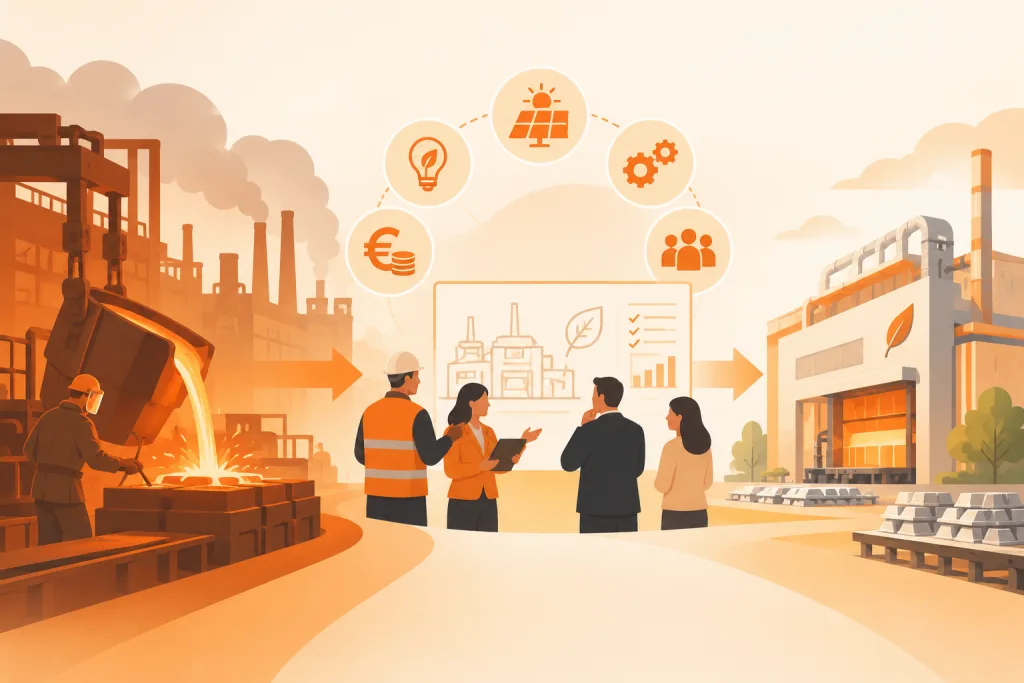
This is where MetalDecarb comes in. Funded under the EU’s LIFE Clean Energy Transition programme, the three-year project aims to bridge the gap between decarbonisation ambitions and practical industrial action by bringing metal manufacturers and sustainable energy technology providers together.
Rather than focusing exclusively on developing new technologies, MetalDecarb will help industrial companies identify existing solutions, assess their suitability and build stronger business cases for investment. Its approach recognises that making industrial decarbonisation achievable requires technical knowledge, financial planning and collaboration across the value chain.
From Energy Challenges to Practical Solutions
The European basic metals and foundry sector faces a complex transition. Energy-intensive processes must become more efficient and less carbon-intensive, while companies continue to meet demanding production standards and remain competitive in global markets.
Although sustainable energy technologies are increasingly available, adopting them is not always straightforward. Companies must assess their technical suitability, understand investment requirements, navigate regulatory frameworks and identify solutions that make financial sense.
A technology that performs well in one industrial environment may require substantial adaptation in another. Differences in production volumes, equipment, energy infrastructure and operating conditions all influence which solutions are appropriate. For industrial decision-makers, understanding these factors is essential before committing resources to major investments.
MetalDecarb addresses these challenges by creating opportunities for direct collaboration between industrial companies and technology providers. Rather than promoting a single technology, the project will assess available solutions and help businesses identify approaches suited to their processes and operational needs.
Its activities will follow the Energy Efficiency First principle, prioritising opportunities to reduce energy demand while considering renewable energy, other sustainable technologies and their wider benefits for businesses.
By combining technical assessments with practical guidance, the project aims to make decarbonisation options more understandable and accessible to companies that may not have extensive internal resources dedicated to energy management or investment planning.
Making Decarbonisation Work for Metal Foundries
Decarbonising metal production is not simply a question of introducing cleaner technologies. Foundries operate under demanding conditions, where high temperatures, continuous production requirements and strict material quality standards leave little room for disruption. Any transition towards lower emissions must therefore consider the realities of industrial operations, including energy costs, equipment lifetimes, investment capacity and workforce expertise.
This is particularly important for smaller foundries, which may face greater difficulties accessing the resources needed to modernise their facilities. Addressing these challenges requires a combination of technical knowledge, economic assessment and cooperation across the industrial value chain.
By connecting decarbonisation ambitions with the practical needs of foundry operators, initiatives such as MetalDecarb can help create a clearer pathway towards more sustainable production. The wider objective is to make lower-carbon metal manufacturing not only technically achievable, but also economically viable, scalable and compatible with Europe’s long-term industrial competitiveness and resilience.
Building the Business Case for Decarbonisation
One of MetalDecarb’s central objectives is to make sustainable energy investments easier to plan and implement.
The consortium will map industrial processes, identify barriers to technology adoption and assess solutions already available on the market. Building on this work, project partners will develop standardised case studies, practical turnkey solutions and supporting business models tailored to the basic metals and foundry sector.
These resources will help companies understand not only the potential energy and emissions savings, but also the financial and operational considerations behind investment decisions.
For example, evaluating a sustainable energy solution involves more than comparing its expected energy consumption with that of existing equipment. Businesses must also consider installation requirements, maintenance, possible production interruptions, financing conditions and the expected return on investment. Such factors can determine whether a technically promising solution becomes a realistic investment opportunity.
MetalDecarb aims to address these considerations through structured assessments and practical examples that companies can use when evaluating their own decarbonisation pathways.
The project will also examine the wider advantages of sustainable energy improvements, including Non-Energy Benefitsand environmental, social and governance (ESG) considerations. Improvements in operational performance, working conditions or environmental management may strengthen the business case for an investment even when they are not immediately reflected in energy bills.
This broader perspective is particularly relevant for companies balancing sustainability objectives with short-term financial pressures. By making the potential benefits and implementation requirements clearer, MetalDecarb aims to support more informed decisions and encourage investment in sustainable industrial operations.
Connecting Industry and Technology Providers Across Europe
A central element of MetalDecarb is collaboration between the companies that need to decarbonise and the organisations offering potential solutions.
The project will establish collaborative activities in Italy, Austria, Spain and Poland, bringing together industrial companies, technology providers, sector associations and energy experts.
These connections are important because industrial decarbonisation cannot be addressed by technology providers or manufacturers working independently. Technology suppliers need to understand the operating conditions, technical constraints and investment priorities of industrial customers. Manufacturers, in turn, need access to reliable information about available solutions, their practical requirements and their potential benefits.
MetalDecarb will encourage this exchange by creating opportunities for stakeholders to share experiences, identify common challenges and explore solutions that respond to real industrial needs.
A tailored capacity-building programme will help participants strengthen their understanding of sustainable energy technologies and develop more effective decarbonisation strategies. Through workshops, knowledge exchange and collaborative activities, the project aims to support companies in moving from initial assessments towards more concrete investment planning.
The international dimension also creates opportunities to compare industrial challenges and approaches across different European markets. Although companies may operate under different national conditions, many of the barriers they face are shared, from limited investment capacity to uncertainty about technology performance and financial returns.
The results will be disseminated beyond the four participating countries, allowing other European industrial companies and stakeholders to benefit from the knowledge, tools and approaches developed throughout the project.
Supporting a More Competitive and Sustainable European Metal Industry
Industrial decarbonisation is often discussed primarily in terms of reducing greenhouse gas emissions. For metal manufacturers, however, the transition is also closely connected to competitiveness, energy security and long-term business resilience.
Reducing unnecessary energy consumption can help businesses manage operating costs and limit exposure to energy price fluctuations. Better investment planning can support the modernisation of industrial facilities, while closer cooperation with technology providers can make sustainable solutions easier to evaluate and adopt.
These considerations are especially significant for Europe’s smaller industrial companies, which play an important role in regional manufacturing supply chains but may have fewer resources available for large-scale transformation.
MetalDecarb’s approach is designed to respond to this reality. By developing practical tools, strengthening industrial knowledge and improving connections between stakeholders, the project seeks to make decarbonisation more accessible to businesses with different levels of technical and financial capacity.
Its contribution will therefore extend beyond the individual companies participating directly in project activities. The methods, case studies and lessons learned can provide useful references for other manufacturers facing similar decisions, supporting the wider uptake of sustainable energy solutions across Europe’s basic metals and foundry sector.
EEIP’s Role in MetalDecarb
As a consortium partner, Energy Efficiency in Industrial Processes (EEIP) leads the project’s communication, dissemination and stakeholder engagement activities.
EEIP will help connect MetalDecarb’s findings with the wider European industrial community, ensuring that practical resources, case studies and lessons learned reach companies, technology providers, policymakers and other relevant stakeholders.
This includes communicating the project’s activities and results in an accessible way, supporting stakeholder involvement and encouraging the exchange of knowledge between the consortium and related European initiatives.
Drawing on its European network and experience in industrial energy efficiency, EEIP will contribute to making the project’s resources visible and useful beyond the immediate consortium. An important part of this work will be translating technical findings into information that industrial stakeholders can understand and apply when considering their own decarbonisation opportunities.
For EEIP, MetalDecarb represents an opportunity to support industrial decarbonisation where it matters most: turning available knowledge and technologies into practical, financially viable action for European manufacturers.
As the project progresses, EEIP will share updates, insights and resources developed by the consortium, helping stakeholders follow MetalDecarb’s work and explore opportunities to contribute to a more energy-efficient European metal industry.
Explore further
Funding Acknowledgement
MetalDecarb is co-funded by the European Union under the LIFE Programme, grant agreement No. 101293680.
Views and opinions expressed are those of the author(s) only and do not necessarily reflect those of the European Union or CINEA. Neither the European Union nor the granting authority can be held responsible for them.
