
The transition to climate-neutral transport and industry depends on accelerating the development and deployment of sustainable biofuels. Achieving this goal requires not only technological innovation but also strong collaboration between research projects, industry leaders and policymakers.
This collaborative approach took centre stage at the 33rd European Biomass Conference and Exhibition (EUBCE 2026) in Valencia, Spain, where the Horizon Europe projects CAPTUS, SUSTEPS and SUNFUSION organised a joint workshop exploring the future of sustainable biofuels and circular carbon utilisation.
As the communication and dissemination partner in CAPTUS, EEIP is pleased to share this important project milestone and highlight how collaboration across European research initiatives is helping accelerate the transition towards sustainable energy systems.
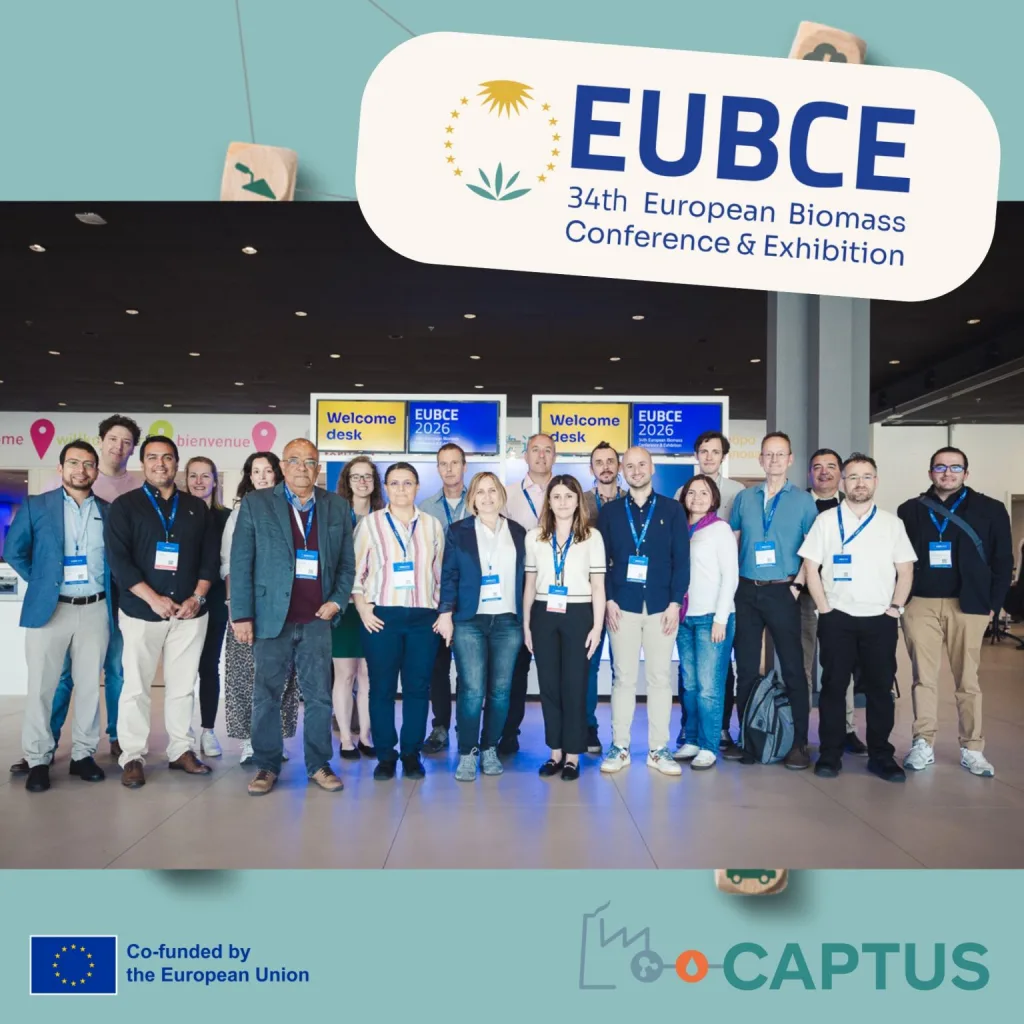
Bringing Together Expertise on Sustainable Renewable Fuels
The joint workshop showcased how three complementary Horizon Europe projects are contributing to the development of innovative renewable fuel pathways capable of reducing emissions from sectors that are difficult to electrify.
Experts presented advances in sustainable biomass utilisation, carbon capture and utilisation (CCU), renewable fuel production and integrated conversion technologies designed to support Europe’s long-term decarbonisation objectives.
By bringing together multiple projects with complementary expertise, the event demonstrated the value of collaboration in accelerating innovation, sharing knowledge and strengthening the European renewable fuels ecosystem.
Discussing the Future of Sustainable Aviation Fuels
One of the highlights of the workshop was a keynote presentation by Dr Kyriakos Maniatis, who explored the evolving policy landscape and future opportunities for Sustainable Aviation Fuels (SAF) in Europe.
The session examined the growing role of renewable fuels in reducing emissions from aviation while highlighting the importance of supportive policy frameworks, continued investment and technological innovation. Participants discussed how research projects can help bridge the gap between laboratory development and industrial deployment.
The programme also included a high-level roundtable discussion, where experts from research, industry and policy exchanged perspectives on scaling renewable fuel technologies and strengthening Europe’s energy resilience.
Collaboration Driving Greater Impact
Beyond the technical presentations, the workshop demonstrated how collaboration between Horizon Europe projects can amplify the impact of individual research initiatives.
Alongside the workshop, CAPTUS, SUSTEPS and SUNFUSION welcomed visitors to a shared exhibition stand, providing an opportunity to discuss project developments, exchange knowledge and engage with stakeholders from across the bioenergy and renewable fuels sectors.
These interactions help strengthen connections between research, industry and policymakers while encouraging the uptake and future replication of innovative low-carbon technologies.
Supporting Europe’s Renewable Energy Transition
The discussions at EUBCE reinforced the importance of integrating carbon capture, renewable energy and sustainable feedstocks to create circular fuel production pathways capable of supporting Europe’s climate objectives.
By developing innovative technologies and working alongside complementary European initiatives, CAPTUS contributes to advancing renewable fuel solutions that can help decarbonise hard-to-abate sectors while improving resource efficiency and supporting Europe’s long-term energy security.
EEIP continues to support the communication and dissemination of CAPTUS, helping ensure that project developments, knowledge and results reach the stakeholders who can contribute to their wider adoption and impact.
Learn More About CAPTUS
CAPTUS is developing innovative carbon capture, utilisation and renewable energy solutions that support industrial decarbonisation and the production of sustainable energy carriers. Bringing together research organisations, industrial partners and innovation experts from across Europe, the project aims to accelerate the transition towards a more circular and climate-neutral industrial future.
To learn more about the project, its partners and the latest developments, visit the official CAPTUS website:
CAPTUS is funded by the European Union under Horizon Europe Grant Agreement No. 101118265.
Views and opinions expressed are however those of the author(s) only and do not necessarily reflect those of the European Union or the European Commission. Neither the European Union nor the granting authority can be held responsible for them.
