
Many industrial facilities across Europe were built decades ago, long before today’s energy efficiency targets, carbon reduction commitments and digital manufacturing technologies became priorities. Replacing entire production plants is often economically unfeasible and operationally disruptive, particularly for energy-intensive industries that depend on continuous production. The RETROFEED project addresses this challenge by developing innovative industrial retrofitting solutions that enable existing manufacturing plants to become more energy-efficient, resource-efficient and environmentally sustainable without requiring complete replacement.
Modernising existing industrial infrastructure offers one of the fastest and most cost-effective pathways towards industrial decarbonisation. By integrating advanced digital technologies, process optimisation, waste heat recovery and flexible energy management into existing facilities, the RETROFEED project helps manufacturers improve performance while reducing energy consumption, emissions and operating costs.
What is the RETROFEED Project?
The RETROFEED project is a Horizon 2020 initiative focused on improving the sustainability and competitiveness of Europe’s process industries through advanced industrial retrofitting strategies.
Rather than replacing existing production plants, the project develops integrated technologies and methodologies that enable industries to upgrade current facilities with modern energy-efficient solutions. This approach allows companies to achieve significant environmental improvements while avoiding the high costs and operational disruption associated with constructing entirely new manufacturing plants.
RETROFEED combines process optimisation, digital monitoring, advanced control systems, waste heat recovery and flexible energy management to improve the overall performance of industrial operations. By integrating multiple technologies into existing production systems, the project demonstrates how industrial facilities can reduce energy consumption while maintaining product quality, productivity and operational reliability.
The project focuses particularly on energy-intensive process industries, where even small improvements in efficiency can deliver substantial reductions in energy use, greenhouse gas emissions and production costs.
Why Industrial Retrofitting Matters
Industrial retrofitting has become one of the most important strategies for achieving Europe’s climate and energy objectives.
Thousands of manufacturing plants across Europe are expected to remain operational for many years. While new low-carbon factories will play an important role in the future, most industrial emissions over the coming decades will continue to originate from existing facilities.
Improving the performance of these plants therefore represents a major opportunity to accelerate industrial decarbonisation. Retrofitting allows manufacturers to modernise equipment, optimise production processes and integrate digital technologies without interrupting production or making prohibitively expensive capital investments.
In addition to reducing greenhouse gas emissions, industrial retrofitting improves energy efficiency, lowers operating costs, increases production flexibility and extends the lifetime of valuable industrial assets.
Modernising Existing Manufacturing Facilities
The RETROFEED project develops practical solutions that enable manufacturers to improve plant performance using integrated optimisation strategies.
A key aspect of the project is the combination of multiple complementary technologies rather than relying on a single innovation. These include advanced process monitoring, predictive control systems, digital decision-support tools, waste heat recovery technologies, flexible energy management and resource efficiency improvements.
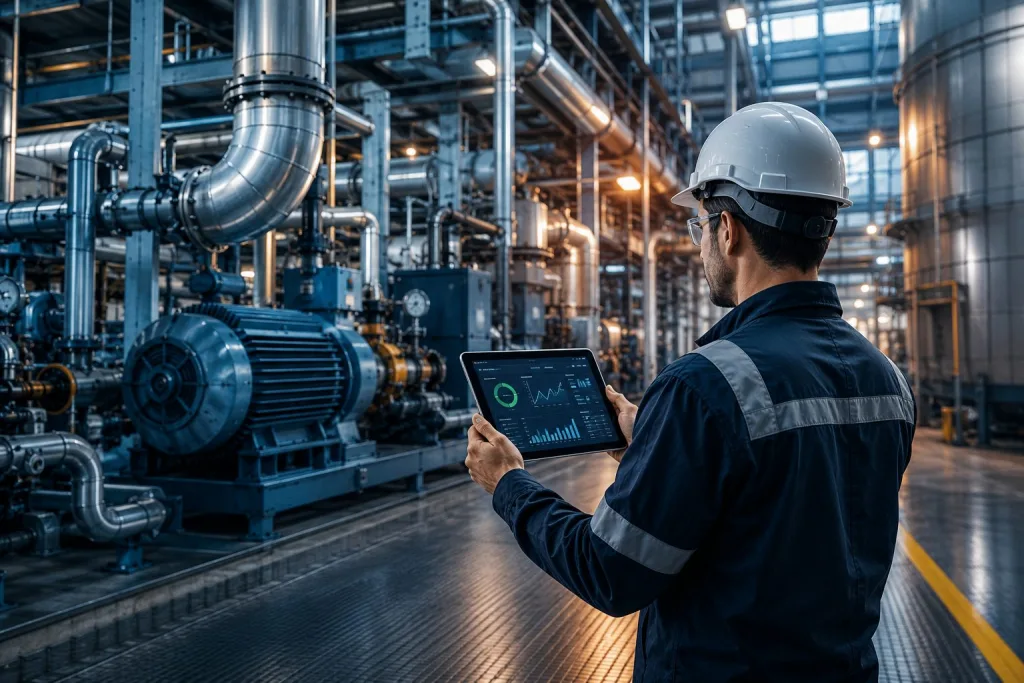
Digital technologies play an important role by providing operators with real-time information on plant performance, energy consumption and process conditions. These insights help identify opportunities for optimisation while supporting more efficient production planning and maintenance.
The project also investigates how industrial plants can become more adaptable to changing production requirements, fluctuating energy prices and increasing integration of renewable energy sources. Improving operational flexibility enables manufacturers to respond more effectively to future market and energy challenges.
Demonstrating Solutions in Real Industrial Environments
One of the defining characteristics of the RETROFEED project is its strong emphasis on industrial validation.
The project demonstrates its retrofitting solutions across multiple industrial sectors, allowing technologies to be tested under real operating conditions rather than only in laboratory environments. These demonstrations evaluate technical performance, energy savings, operational reliability and economic feasibility within existing manufacturing facilities.
By validating solutions in active production plants, RETROFEED provides industries with practical evidence that retrofitting strategies can deliver measurable improvements without compromising productivity or product quality.
The experience gained through these demonstrations also supports future replication, enabling manufacturers across Europe to adopt proven approaches for improving energy and resource efficiency.
Supporting Europe’s Industrial Decarbonisation
Achieving climate neutrality will require both breakthrough technologies and the modernisation of existing industrial infrastructure.
The RETROFEED project contributes directly to Europe’s Green Deal and industrial decarbonisation objectives by demonstrating that existing manufacturing facilities can achieve significant environmental improvements through targeted retrofitting measures.
Reducing energy consumption not only lowers greenhouse gas emissions but also improves industrial competitiveness by reducing operating costs and increasing resilience to energy market volatility. At the same time, improved resource efficiency helps manufacturers minimise waste and optimise production processes.
By promoting practical, scalable retrofitting solutions, RETROFEED supports the transition towards a cleaner, smarter and more competitive European manufacturing sector.
Why the RETROFEED Project Matters
The RETROFEED project demonstrates that industrial decarbonisation does not always require building entirely new factories. Through innovative industrial retrofitting solutions, existing manufacturing facilities can significantly improve energy efficiency, reduce emissions and increase operational flexibility while continuing to meet demanding production requirements.
By combining digital technologies, process optimisation, waste heat recovery and advanced energy management, RETROFEED provides industries with practical pathways for modernising existing infrastructure. Its work contributes to a future where Europe’s manufacturing sector remains globally competitive while progressing towards climate neutrality and more sustainable industrial production.
Explore further
Funding Acknowledgement
This project has received funding from the European Union’s Horizon 2020 research and innovation programme under Grant Agreement No. 869939.
Views and opinions expressed are however those of the author(s) only and do not necessarily reflect those of the European Union or the European Commission. Neither the European Union nor the granting authority can be held responsible for them.
