
Hydrogen is expected to play a central role in Europe’s transition towards a climate-neutral economy, supporting the decarbonisation of industry, transport and energy systems. However, producing hydrogen sustainably remains one of the sector’s greatest challenges. Most hydrogen is still produced using fossil fuel-based processes that generate significant carbon emissions. The STORMING project addresses this challenge by developing innovative technologies for clean hydrogen production based on advanced methane cracking, offering a promising alternative to conventional hydrogen manufacturing methods.
Unlike traditional steam methane reforming, methane cracking separates natural gas into hydrogen and solid carbon without producing carbon dioxide as a direct reaction product. By combining advanced reactor technologies, innovative catalysts and industrial validation, the STORMING project is helping pave the way for more efficient, scalable and lower-carbon hydrogen production systems capable of supporting Europe’s industrial decarbonisation ambitions.
What is the STORMING Project?
The STORMING project is a Horizon Europe initiative focused on advancing clean hydrogen production through catalytic methane cracking technologies.
Conventional hydrogen production methods generate large amounts of carbon dioxide that must either be released into the atmosphere or captured using carbon capture and storage technologies. Methane cracking provides an alternative pathway by splitting methane into hydrogen gas and solid carbon, avoiding the direct formation of carbon dioxide during the production process.
The project develops innovative structured reactor technologies and advanced catalytic systems that improve methane conversion, increase hydrogen production efficiency and enhance operational stability under industrial conditions.
Rather than focusing solely on laboratory research, STORMING validates its technologies through industrial demonstrations, helping prepare methane cracking for future commercial deployment across Europe’s energy-intensive industries.
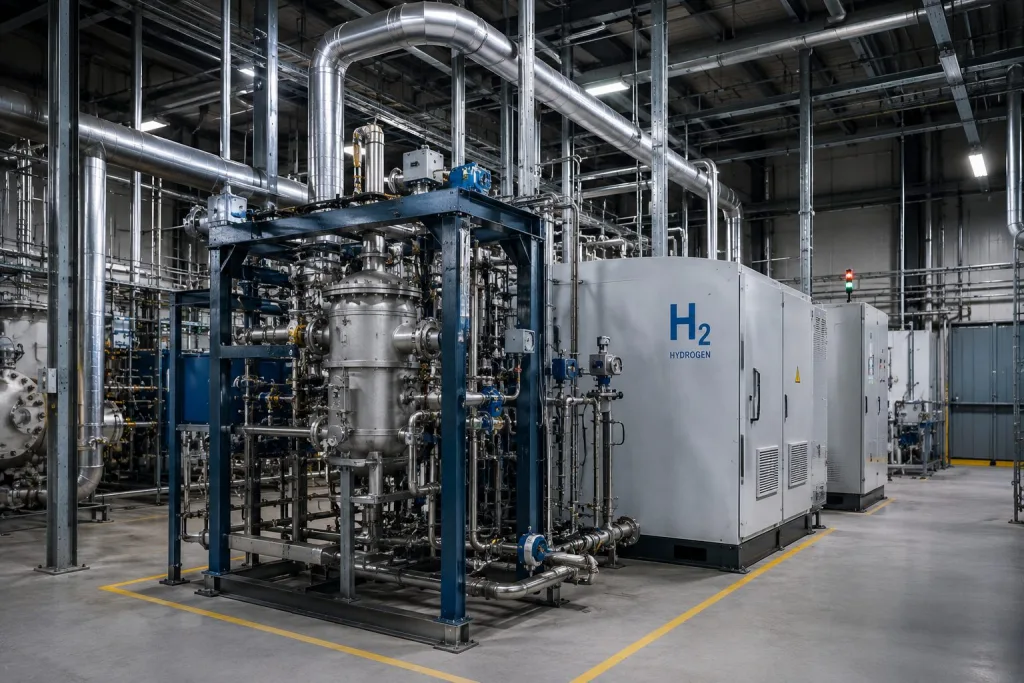
Why Clean Hydrogen Production Matters
Clean hydrogen production is becoming increasingly important as Europe works towards achieving climate neutrality by 2050.
Hydrogen is expected to play a major role in sectors where direct electrification remains difficult, including steel production, chemicals, heavy transport and other energy-intensive industries. Producing sufficient quantities of low-carbon hydrogen is therefore essential for reducing emissions while maintaining industrial competitiveness.
Current hydrogen production is dominated by steam methane reforming, a mature but carbon-intensive process. While renewable electrolysis offers another promising pathway, it requires large quantities of renewable electricity that may not always be available at industrial scale.
Methane cracking provides an additional low-carbon hydrogen production route that can complement other technologies while reducing direct carbon emissions and improving resource efficiency.
Advancing Methane Cracking Technologies
A central objective of the STORMING project is improving the performance of methane cracking through innovative reactor design and catalyst development.
The project develops structured catalytic reactors capable of enhancing heat transfer, increasing methane conversion efficiency and improving hydrogen production under demanding industrial operating conditions.
Researchers also investigate catalyst behaviour, reactor optimisation and process integration to maximise operational stability and reduce energy consumption throughout the production process.
An important advantage of methane cracking is that the carbon contained in methane is recovered as solid carbon rather than released as carbon dioxide. Instead of becoming waste, this solid carbon has the potential to serve as a valuable industrial raw material for a range of applications, improving both the environmental and economic performance of the overall process.
By transforming carbon into a useful product rather than an emission, STORMING contributes to more circular and resource-efficient industrial production.
Demonstrating Industrial Hydrogen Technologies
One of the defining features of the STORMING project is its strong focus on industrial validation.
The project evaluates methane cracking technologies under realistic operating conditions, allowing researchers and industrial partners to assess technical performance, hydrogen production efficiency, catalyst durability and operational reliability.
Demonstration activities provide valuable evidence on scalability, process integration and commercial potential, helping reduce technical uncertainties that often delay industrial deployment of emerging hydrogen technologies.
The knowledge generated throughout the project supports future investment decisions and contributes to the wider development of Europe’s hydrogen economy.
Supporting Europe’s Hydrogen Economy
Europe’s future energy system will require multiple complementary pathways for producing low-carbon hydrogen.
The STORMING project contributes directly to this objective by developing practical technologies that expand the portfolio of clean hydrogen production solutions available to industry. Through advances in methane cracking, catalyst development and reactor engineering, the project helps strengthen Europe’s technological leadership in hydrogen innovation.
The project also supports broader European objectives related to industrial competitiveness, energy security and greenhouse gas emission reduction. By improving production efficiency while creating valuable solid carbon co-products, STORMING demonstrates how hydrogen technologies can become both environmentally and economically attractive.
As demand for hydrogen continues to grow, innovative production methods such as methane cracking will become increasingly important components of Europe’s clean energy transition.
Why the STORMING Project Matters
The STORMING project demonstrates that clean hydrogen production can be achieved through innovative methane cracking technologies that reduce direct carbon emissions while improving industrial efficiency.
By combining advanced catalytic reactors, process optimisation and industrial demonstration, the project helps accelerate the development of scalable hydrogen production technologies capable of supporting Europe’s transition towards climate-neutral industry.
Its work contributes not only to cleaner hydrogen production but also to stronger industrial competitiveness, improved resource efficiency and a more sustainable European energy system.
Explore further
Funding Acknowledgement
This project has received funding from the European Union’s Horizon 2020 research and innovation programme under Grant Agreement No. 101069690.
Views and opinions expressed are however those of the author(s) only and do not necessarily reflect those of the European Union or the European Commission. Neither the European Union nor the granting authority can be held responsible for them.
